Nobody notices parking lot lines.
It’s only once they’ve faded into a gray blur, once the crosswalk is basically a suggestion and the arrows have worn down to nothing, that people start feeling like the lot got somehow more chaotic without anyone touching a thing.
Lines are the rare piece of infrastructure that only get credit by way of complaint about their absence.
What Unmarked Pavement Actually Forces People to Do
Take the lines away and every driver is suddenly guessing. Where does this lane end. Which way does traffic move through here. Is that patch of asphalt a stall or just open space someone could park a shopping cart on.
None of these are big questions individually. Stacked across dozens of drivers a day, they’re exactly where fender benders and near misses come from.
Striping removes the guessing. It tells a driver where to go, at what angle, without making them think about it. That’s the whole job, really, offloading a hundred small decisions onto the pavement instead of making a driver work them out live, in traffic, under pressure.
Flow Improves More Than People Expect
In parking lots specifically, good striping speeds things up in a way that’s easy to underestimate.
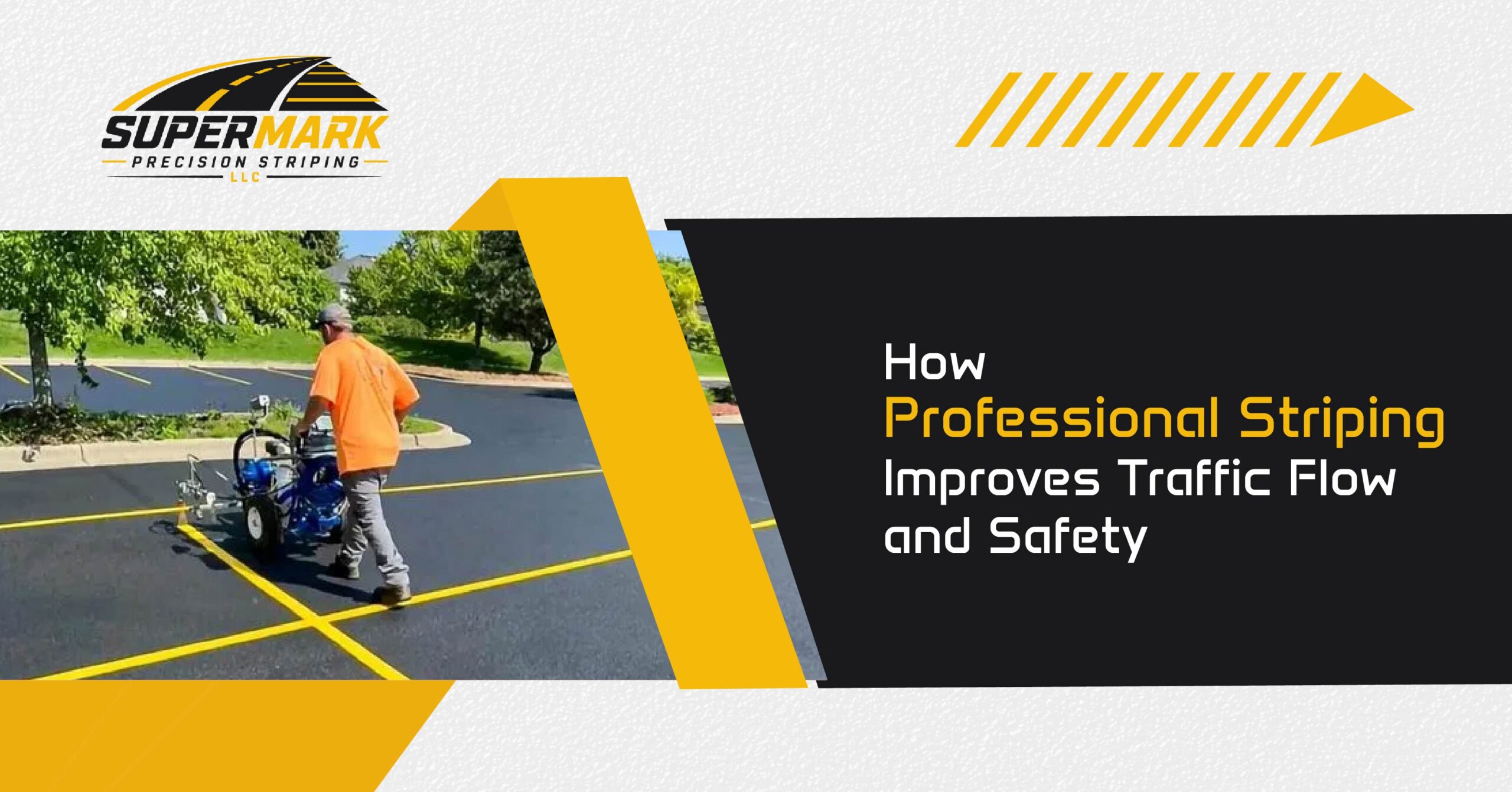
Clear lanes, arrows, and stall lines cut down on hesitating, backing up, circling twice for a spot that was there the whole time. In a busy retail lot or hospital garage, that adds up fast, a well-marked lot simply moves more cars per hour than an identical one with faded lines.
- Arrows kill the wrong-way confusion that shows up constantly in unmarked lots
- Clear stalls stop the double-parking and wasted space that comes with fuzzy boundaries
- Marked fire lanes keep emergency access clear, which nobody thinks about until the one day it matters
- Crosswalks pull foot traffic into predictable paths instead of scattering it everywhere
The Safety Case Goes Deeper Than It Looks
Clear lines, fewer accidents, sure. But the specifics carry more weight than the general statement.
ADA-compliant stalls and access aisles aren’t paperwork, they’re the difference between someone safely getting out of a car and someone forced into a traffic lane to do it. Fire lanes matter in exactly the moments nobody has time to think. Crosswalks near schools and hospitals measurably cut pedestrian accidents where foot traffic is heaviest.
Reflectivity matters too. A huge share of parking lot incidents happen after dark or in bad weather, and paint that actually reflects headlights properly extends safe navigation well past daylight.
Faded Lines Are a Liability, Not Just an Eyesore
Restriping gets treated as a cosmetic line item a lot of the time, something to get to eventually. That framing misses the real risk. If an accident happens in a lot with markings that were obviously overdue, that becomes a real fact in whatever claim follows.
Twelve to twenty-four months is the general window most properties should be restriping on, depending on climate and traffic volume, and skipping past that window is a genuine exposure, not just a look.
What Actually Goes Into Doing This Right
Real layout planning accounts for code requirements, ADA compliance, turning radius, fire lane placement, none of it eyeballed.
Commercial-grade paint or thermoplastic, applied with equipment built for it, holds up to traffic and weather in a way hand-applied lines generally don’t.
Get the layout wrong and none of the paint quality matters. The lines just won’t function the way they’re supposed to once real cars and real people are actually using the space.
If your lot’s markings have faded, it’s worth a closer look.
Super Mark Striping provides professional pavement marking services built to improve traffic flow, safety, and code compliance for parking lots and commercial properties.
Visit supermarkstriping.com to request an estimate.
No comment